





An annual physical exam is a once-a-year preventive visit with your primary care provider. It covers four main things: reviewing your health history and medications, taking basic measurements such as blood pressure and weight, performing a hands-on physical examination, and planning the screenings, lab work, and vaccines you're due for. Most visits take less than an hour.
What varies from person to person is the plan. A healthy 28-year-old and a 62-year-old managing high blood pressure may both come in for an annual physical check up, but they'll leave with very different to-do lists. This guide takes you through each part of the visit in the order it typically happens, explains which screenings apply at different ages, and covers what to bring, what to avoid beforehand, and what to ask while you're in the room.
Here's a quick look at the visit. Each step is explained in more detail below.
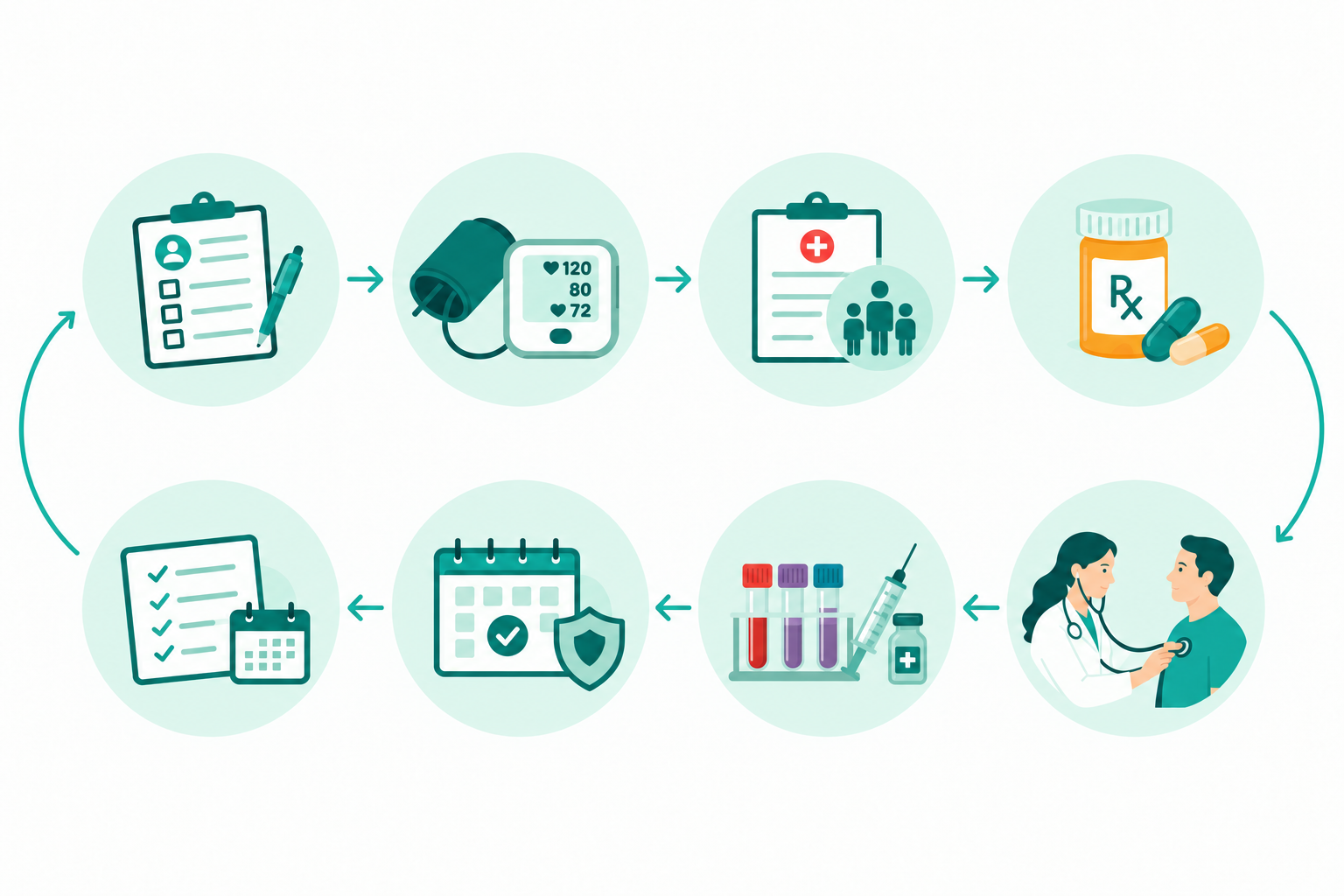
Before meeting your provider, you'll typically confirm your contact and insurance information and complete a short health questionnaire. Many practices also ask a few questions about mood, sleep, alcohol use, and tobacco use.
These questions serve a purpose. The U.S. Preventive Services Task Force (USPSTF) recommends screening adults for depression and unhealthy alcohol use, along with asking every adult about tobacco use. The questionnaire is often the first step in that screening process. Answer honestly; your responses help your provider determine what needs attention during the visit.
A nurse or medical assistant will usually record:
These measurements are especially useful when tracked over time. Blood pressure that gradually rises a few points each year, or weight that changes without a clear reason, often doesn't cause noticeable symptoms. Comparing this year's readings with those from previous visits is frequently how a potential problem is identified early.
The USPSTF recommends blood pressure screening for all adults 18 and older. If your office reading is high, your provider may recommend monitoring it at home before making a diagnosis, since some people have higher readings at the doctor's office than in everyday life. If you already monitor your blood pressure at home, bring your log. (Our guide to lowering blood pressure without medication explains what you can do when your numbers are trending upward.)
Your provider will ask about anything that has changed since your last appointment, including new symptoms, diagnoses from other doctors, surgeries, urgent care or hospital visits, and major life events such as a new job, moving, or pregnancy.
Your family history will also be updated. If a parent, sibling, or other close relative has been diagnosed with heart disease, diabetes, high blood pressure, or cancer, particularly at a younger age, your provider may suggest beginning certain screenings earlier or having them more frequently. Since family history can affect your screening schedule, consider checking with a relative before your appointment if you're unsure about the details.
Don't overlook the smaller changes either: sleeping poorly, getting winded on stairs that used to feel easy, experiencing more frequent heartburn, or noticing a mole that looks different. People sometimes leave these things out because they seem minor, but gradual changes like these are exactly what a once-a-year visit is intended to catch.
You'll be asked to review everything you take, including prescriptions, over-the-counter medicines (pain relievers, antacids, sleep aids, allergy pills), vitamins, and herbal supplements. Supplements are important to mention because some can interact with prescription medications or influence lab results.
Your provider will typically review:
The simplest way to make sure the information is accurate is to bring your medication bottles or photos of their labels.
The hands-on examination is one of the main differences between a physical and most other appointments. It's based on your age, medical history, and current concerns, so not everyone will need every part. However, a typical exam may include:
If you have diabetes, your provider may also examine your feet for sensation and circulation. Breast and pelvic exams aren't automatically included in every adult physical; whether they're appropriate depends on your age, symptoms, screening needs, and preferences. If you'd like one, or would rather skip one, let your provider know.
Your provider will then review which preventive screenings you need. Some are completed during the appointment, such as checking blood pressure and filling out the questionnaire. Others may be ordered during the visit but completed separately, including mammograms, colonoscopies, and bone density scans. You'll find a detailed breakdown by age in the next section.
If blood work is needed, your sample may be collected during the appointment or at a lab afterward. Your provider will also review your vaccination records and recommend any vaccines that are due. Since flu season begins in the fall, scheduling an autumn physical can be a convenient opportunity to ask about your flu shot. AIM Primary Care provides vaccinations and in-office testing, including EKGs, so some of these services can often be completed during the same visit.
Before leaving, make sure you understand four things: whether your medications have changed, which tests or referrals were ordered and where to complete them, how you'll receive your results, and when you should return. If anything is unclear, ask while you're still in the exam room.
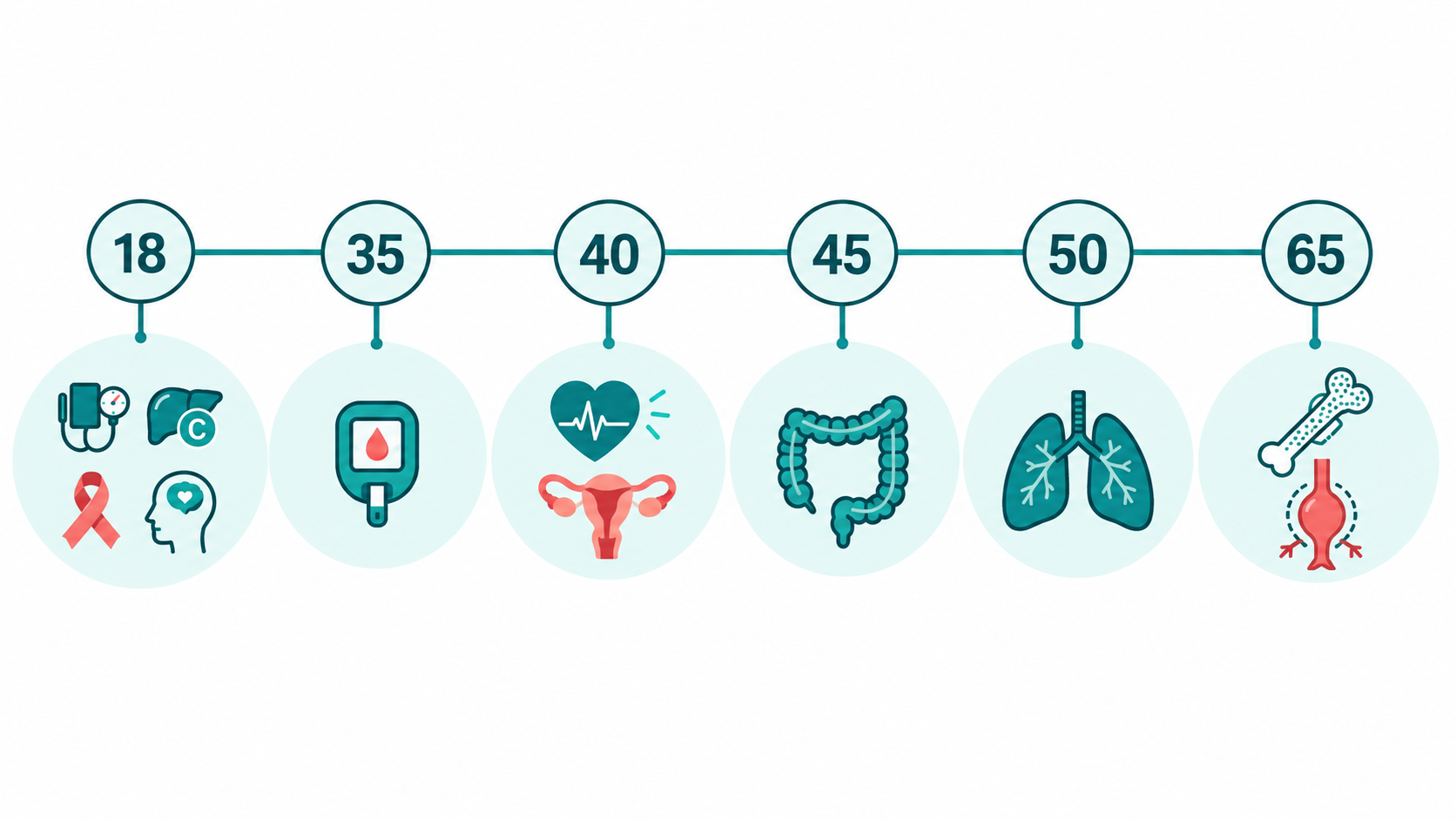
Screening recommendations vary based on age, sex, family history, and individual risk factors. The table below outlines important adult recommendations from the USPSTF, an independent panel of experts whose highest-rated recommendations help determine which preventive services most insurance plans cover. This is a general reference rather than a personalized schedule; your provider may suggest a different approach based on your health history.
| Screening | Generally recommended for | How often |
|---|---|---|
| Blood pressure | All adults 18 and older | Yearly from age 40 or with higher risk; every 3 to 5 years for adults 18 to 39 with normal readings |
| Prediabetes and type 2 diabetes | Adults 35 to 70 with overweight or obesity | About every 3 years if results are normal |
| Cholesterol | Adults of certain ages or at higher risk; used to estimate heart disease risk in adults 40 to 75 | Set by your provider based on your risk |
| Colorectal cancer | Adults 45 to 75 | Depends on the test: yearly for a stool test (FIT), every 10 years for a normal colonoscopy |
| Breast cancer (mammogram) | Women 40 to 74 | Every 2 years |
| Cervical cancer | Women 21 to 65 | Every 3 years (Pap test) from 21 to 29; every 3 or 5 years from 30 to 65, depending on the test |
| Lung cancer (low-dose CT) | Adults 50 to 80 with a 20 pack-year smoking history who still smoke or quit within the past 15 years | Yearly |
| Osteoporosis (bone density) | Women 65 and older, and younger postmenopausal women at higher risk | Set by your provider |
| Abdominal aortic aneurysm | Men 65 to 75 who have ever smoked | Once (ultrasound) |
| Hepatitis C | Adults 18 to 79 | At least once |
| HIV | Ages 15 to 65 | At least once; more often with higher risk |
| Depression | All adults | Usually during routine visits |
| Anxiety | Adults 64 and younger | Usually during routine visits |
A few important details aren't covered in the table:
To understand why staying on schedule is important, read our article on why regular health screenings are essential.
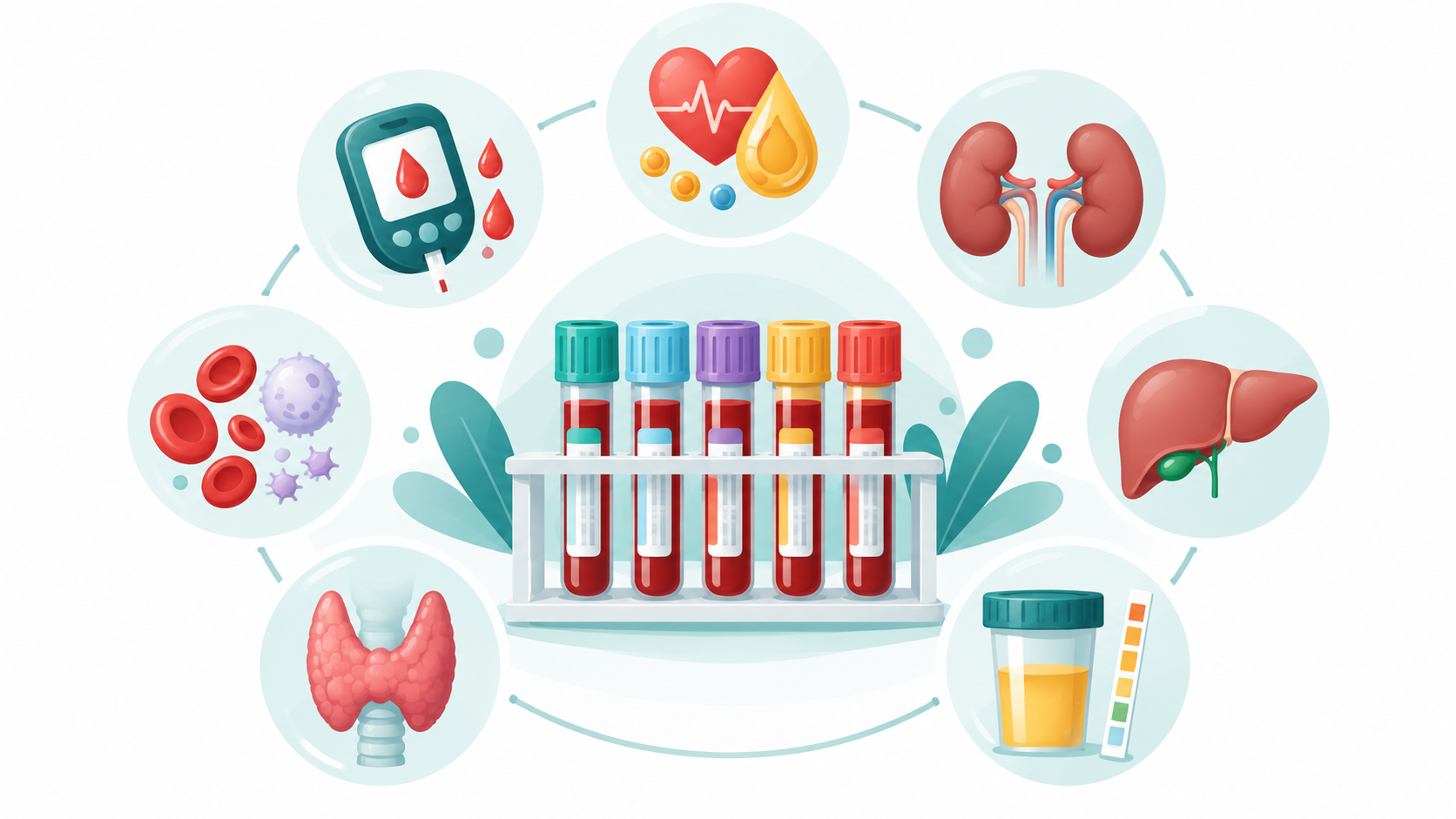
Sometimes. There isn't a standard "annual physical blood panel" that everyone needs. Your provider recommends lab tests based on your age, symptoms, existing health conditions, medications, and past results. A healthy 25-year-old might not need blood work at all, while a person managing diabetes will generally need several tests throughout the year.
Here are the tests commonly ordered around a physical:
| Test | What it measures | Often ordered for |
|---|---|---|
| Lipid panel | Total, LDL, and HDL cholesterol and triglycerides | Heart disease risk assessment or monitoring cholesterol medication |
| Hemoglobin A1C | Average blood sugar over roughly the past three months | Diabetes screening or monitoring |
| Fasting glucose | Blood sugar at a single point in time | Diabetes screening |
| Basic or comprehensive metabolic panel | Kidney function and electrolytes; the comprehensive version adds liver tests | Monitoring certain medications or chronic conditions |
| Complete blood count (CBC) | Red cells, white cells, and platelets | Fatigue, possible anemia, or infection |
| Thyroid-stimulating hormone (TSH) | Thyroid function | Fatigue, unexplained weight change, or known thyroid disease |
| Urinalysis | Signs of infection, kidney problems, or sugar in the urine | Symptoms, diabetes, or kidney monitoring |
Do you need to fast? Only for specific tests. A fasting glucose test requires fasting, and some providers prefer a fasting lipid panel, but an A1C doesn't require it. If you need to fast, you'll receive instructions beforehand, and drinking plain water is fine.
A note on cost: Lab tests ordered for preventive screening are often fully covered. However, tests ordered to investigate symptoms or monitor an existing condition may be billed as diagnostic services, meaning a deductible or copay could apply. If you're concerned about costs, check with your insurance provider before the appointment.
People often use these terms to mean the same thing, and the distinction is relatively small with many private insurance plans. However, with Medicare, the difference is important.
Medicare's yearly Wellness visit focuses on discussion and preventive planning, and Medicare clearly states that it isn't a routine physical exam. The visit centers on a Health Risk Assessment questionnaire and concludes with a written plan for recommended screenings, vaccines, and other preventive services. It also covers routine measurements, a review of your medical history and prescriptions, a cognitive assessment, and an opportunity to discuss advance directives.
| Feature | Annual physical exam | Medicare Annual Wellness Visit |
|---|---|---|
| Main focus | Hands-on clinical evaluation plus prevention | Prevention planning and risk assessment |
| Hands-on physical exam | Yes | No; routine measurements only |
| Health risk questionnaire | Often | Yes |
| Cognitive assessment | When relevant | Yes |
| Advance directives discussion | Sometimes | Offered |
| Typical coverage | Most private plans cover one preventive visit a year | Medicare Part B, once every 12 months |
Two Medicare rules sometimes surprise patients. First, you can't have your first Wellness visit within 12 months of enrolling in Part B or receiving your "Welcome to Medicare" preventive visit. Second, Original Medicare doesn't cover routine physical exams. If services beyond the Wellness benefit are provided during the same appointment, you could be responsible for some or all of the cost. Certain Medicare Advantage plans include an annual routine physical as an extra benefit, so review your coverage.
The practical takeaway: be specific about the type of appointment you want when booking. Our annual wellness exam team can help you determine which visit is appropriate for your coverage.
Spending ten minutes preparing can make your appointment much more productive. Bring:

If you're visiting AIM Primary Care for the first time, completing the patient registration form ahead of your appointment and sending a medical records release to your previous doctor can help save time.
Choose comfortable clothing, preferably with sleeves that can be rolled up easily for the blood pressure cuff or a blood draw.
A few everyday habits can affect your results or take up valuable appointment time:
Don't fast unless instructed to. If you've been asked to fast, drink plain water. If you take diabetes medication, ask your provider whether your dose needs adjusting to prevent your blood sugar from dropping too low.
Don't skip your regular medications unless your provider specifically advises you to.
Don't consume caffeine, smoke, or exercise within 30 minutes of your appointment. The American Medical Association recommends avoiding all three before a blood pressure reading because they can temporarily raise your numbers.
Don't schedule an intense workout or drink heavily the night before blood work. Both activities can temporarily change certain lab results, including triglycerides and muscle enzymes.
Don't arrive at the last minute. Getting there 10 to 15 minutes early allows time to check in and sit quietly before your blood pressure is measured.
Don't use the restroom without first checking whether a urine sample is needed.
Don't wait until the end to mention your main concern. If something has been worrying you, bring it up early so there's enough time to discuss it. If further evaluation is necessary, your provider may arrange a separate appointment, which could affect billing.
The best questions are the ones that relate to your individual health. Here are a few worth considering:
Which screenings am I due for this year, and which can wait?
How do my numbers compare with last year's?
Does anything in my family history change my screening schedule?
Do any of my medications need lab monitoring, and could any be stopped?
Which vaccines am I due for?
If I could change one habit, which would make the biggest difference for my health?
How will I get my results, and what happens if something comes back abnormal?
When should I schedule my next visit?

Your visit doesn't completely end when you leave the office. A few follow-up steps help you get the most from it:
Check your results. AIM Primary Care patients can access their test results and messages through the patient portal.
Schedule your referrals. Mammograms, colonoscopies, and imaging tests such as X-rays are typically performed at outside facilities, and you'll need to book those appointments.
Follow up on anything abnormal. A single result outside the normal range doesn't always indicate a problem, but it's worth discussing. If you have an ongoing health condition, regular chronic illness management visits can help you manage it between physicals.
Don't wait a year if you become sick. Annual physicals focus on preventive care. If you develop a new illness or injury, schedule a sick visit instead.
If you've been delaying your yearly appointment, our article on why you shouldn't skip preventive health checkups explains why these visits matter.
At AIM Primary Care, Dr. Sujatha Gerineni, a board-certified internist, leads wellness and preventive exams. Each appointment is planned around your age, medical history, and health goals, helping you leave with a clear plan rather than a one-size-fits-all checklist.
We welcome adult patients at two San Antonio locations:
Walkers Way: 1418 Walkers Way, Suite 101, San Antonio, TX 78216 · (210) 245-7933
City Base West: 7003 S. New Braunfels Ave., Suite 101, San Antonio, TX 78223 · (726) 201-5616
Both locations are open Monday through Friday, from 8 AM to 5 PM, and accept most major health insurance plans, including Medicare. You can also view the full list of insurance we accept.
Schedule your annual physical exam online and choose an appointment time that fits your schedule.
Most appointments take less than an hour, including check-in and vital signs. Your visit may take longer if you're a new patient, have multiple health conditions to discuss, or need blood work completed during the appointment.
Only when your provider orders a test that requires fasting, such as a fasting glucose test. Many common tests, including the A1C, don't require it. If you're uncertain, contact the office a day or two before your visit.
Usually, but it's important to check your specific plan. According to HealthCare.gov, all Marketplace plans and many other insurance plans must cover certain preventive services without copays or coinsurance when you visit an in-network provider, although $0 isn't guaranteed in every situation. Original Medicare covers a yearly Wellness visit but doesn't cover a routine physical exam.
An annual physical looks at your overall health and focuses on prevention. A sick visit is intended to evaluate and treat a specific current concern, such as an infection, injury, or new symptom.
There isn't one national rule for everyone, but most adults have a physical once a year, which generally matches how insurance plans cover preventive visits. If you're managing a chronic health condition, your provider may recommend more frequent appointments.
Avoid caffeine, smoking, and exercise for at least 30 minutes beforehand. Don't fast unless instructed, continue taking your usual medications unless your provider says otherwise, and avoid heavy drinking or intense workouts the day before blood work.
Disclaimer
This article provides general information and shouldn't replace professional medical advice. Screening and testing recommendations may change over time and depend on your individual health history. Speak with your healthcare provider about what's appropriate for you. Screening guidance reflects USPSTF recommendations as of October 2026.
Banner Image Source: ChatGPT


